Another year has passed. Three-hundred-and-sixty-five days lived and experienced by all surviving humans, animals, plants, fungi, protozoans, and whatever other entities yet unknown to us. Of course, not all organisms who entered 2023 made it to 2024. Some survived days, others months. Some survive for mere moments, transiently passing from one plane to the next. Take for instance the dainty mayfly; the earthling with the shortest natural lifespan of any earthling.
Once a mayfly emerges from its sub-imago form and molts into its sexually-mature imago (adult) form, the male mayflies will swarm above a body of freshwater and await to intercept a newly-adult female mayfly flying into the swarm. The pair will mate in midair, and the female mayfly will fall onto the surface of the water with its fertilized eggs dropping off and sinking to the bottom to begin the incubation process on the floor of the water. The female mayfly will become food for fish, and the male mayfly will go somewhere else on land to die and be eaten by another creature. This process can last anywhere from five minutes to twenty-four hours and is repeated by trillions of mayflies each year, providing fish, amphibians, reptiles, small mammals, and other insects with an abundant source of food and energy for their own life mission.
The mayfly belongs to the ancient insect order of Ephemeroptera, a part of the Palaeoptera group containing dragonflies and damselfies. The term Ephemeroptera connotes the ephemeral nature that has served as an accessory to several works of art including Albrect Dürer’s engraving, The Holy Family with the Mayfly, and Aristotle’s History of Animals. Aristotle describes the mayfly (ephemeron) as “an exceptional existence” for its transient nature and uniquely quadruped appearance despite being a winged insect.
In Dürer’s Holy Family engraving, the mayfly accompanies a woman and her child embracing in a meadow below God residing in the sky. While it’s possible for the depicted insect to be a butterfly, dragonfly, or a mayfly, the symbolic juxtaposition of a metamorphic insect with woman, child, and God, explicitly and paradoxically connects change, impermanence, ephemera, with God, the omnipresent force that codes the natural world. In their essays contained in Merchants and Marvels, Larry Silver and Pamela Smith propose an explanation for the symbolism behind the mayfly and its inclusion in Dürer’s engraving:
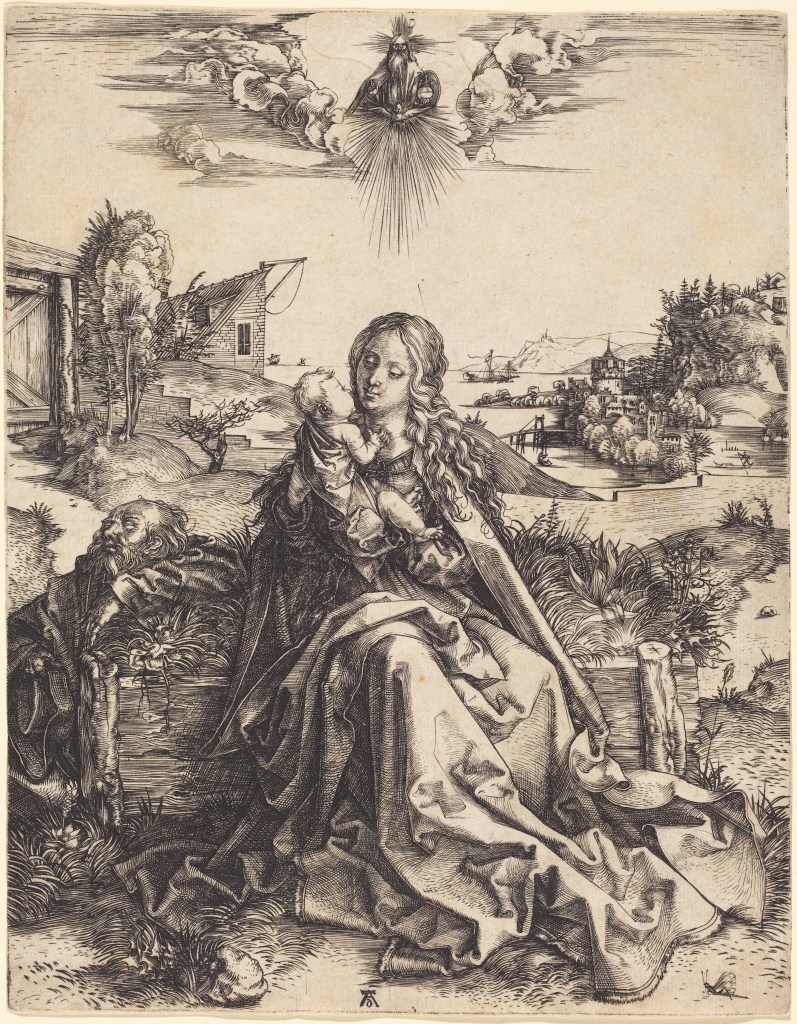
“an explicit link between heaven and earth … to suggest a cosmic resonance between sacred and profane, celestial and terrestrial, macrocosm and microcosm”
So for hundreds of years, thousands even, the ephemeral nature of the mayfly has inspired expressionists from all walks of life to reflect on their role within the cosmos, their relationship with nature, and their perception of time.
I am reminded of the winning poem from Tricycle magazine’s Haiku Challenge:
a problem of shape—
the human life, long, narrow—
like a dragonfly
-Mariya Gusev
The dragonfly presents a problem of shape, for when compared to a human life, long and narrow, the life of a dragonfly is short like a mayfly’s. Gusev also brings to light an additional problem of shape: the human life, long and narrow. Is the problem that life is too long or that it is too narrow? As former senior editor at Tricycle, Clark Strand, puts it, “the life of a modern Homo sapiens is too long for its width, too narrow for its length.” The modern shape of human life is incongruent with its characteristic quality to belong to nature; not inclusively expansive enough for its outline.
We’ve narrowed the range of our experiences through the modern institutions which we’ve surrendered control to in exchange for convenience, comfort, and capital gain. Our quest for growth and expansion came at the expense of our Earth, the home we all belong to, and paradoxically shrunk the projection of our experience so far negatively that we’ve shifted towards a virtual reality. We can no longer grow physically wide without further consuming more of the limited resources available to us, we now have to grow digitally inward, and that too requires unsustainable consumption.
An ouroboric cycle; a problem of shape.
What would happen if a mayfly were to remove itself from the natural world? What would happen if the trillions of mayflies who’s life rarely ever exceeds a couple hours suddenly cease to exist?
Ecological collapse, surely. For the prey animals that depend on the abundance of mayflies for energy would dwindle in population and cause a chain reaction in the predators which depend on the prey; and on the flora that’d be overconsumed by other animals indirectly affected by the destabilization of the mayfly’s immediate inter-dependents. Suddenly, those five minutes that a mayfly is alive become the most important five minutes ever.
What would happen if humans continue to exist separate from the natural world? How much more can we destabilize our natural and social ecosystems before we experience complete environmental collapse?
Perhaps the experiences that await us in 2024 will contain further insight into reconciling our budding eco-existential dilemmas. Regardless of what 2024 has in store for us, we can appreciate all of the unprecedented experience gained throughout 2023.
If 2023 was a tough year for you, you are not alone. Personally, it was one of the most challenging years of my life for highly personal reasons that involved major changes to several of my significant personal relationships. Obviously, adversity is not a new human experience, but the modern ways of experiencing adversity is truly novel. The frontier on which we’re all situated against places us in front of an abyss of paradoxical unpredictability, and human life, long and narrow, is a dart flying straight towards it at unprecedented speeds. Days feel shorter and shorter. Our collective awareness grows narrower and narrower as the spread of information becomes faster and faster, and our digital presence replaces our physical presence little by little by the algorithms we voluntarily accepted the terms and conditions of.
How do we assimilate the massive amounts of information into our awareness when our processing systems feel overwhelmed and overworked by our own oppressive issues, especially in the wake of the global suffering we witness daily? How do we navigate the cognitive dissonance that arises from wanting to support people on the margins and being painfully aware of our capability to access our western privileges in the blink of an eye by easily turning off our phones?
As an active participant, I cannot say for sure, but if I learned anything through weathering the storm that was 2023, it is that accepting all things as they are – the good, the bad, and the ugly – precipitates peace long enough to obtain understanding. To paraphrase journalist Anne C. Klein, when I relax, my obsessions relax. When my obsessions relax, I can see.
Acceptance here does not suggest complacency, instead, acceptance invites action through the release of the judgmental expectations that suppress clarity and compassion. And while sometimes acceptance might warrant inaction, the clarity that arises from releasing expectations carries within itself the opportunity to respond maturely and responsibly. Acceptance is a practice just like any other habit or routine we become accustomed to through consistency, but the more we can indiscriminately accept our inner experience, our privilege, and others’ assertive right to exist equally, the further we can develop our individual and collective disposition towards a more conscious, compassionate, and empathetic society. For when we can all acknowledge that we feel similarly confused, exploited, manipulated, and disenfranchised, we can take steps towards reconciling the different reasons for our shared burden. In his book, Tattoos on the Heart, Father Gregory Boyle describes compassion as what precipitates the “dismantling of barriers” to achieve kinship – what happens when we remember we belong to each other.
After all, the losses we all experience as humans living a human life will never end. The impermanence of life and life’s circumstances is as omnipresent as God itself. They say the only two guarantees in life are death and taxes, but that includes the attachment tax: there is no love without the risk of heartbreak, no success without the risk of failure, no coming to consciousness without pain, no life without death. The nature of life is a yin-yang where breakups, trauma, colonization, debt, hunger, death, and disease coexist with (and often precipitate) viral Tik Tok dances, internet memes, modern political crises, artificial intelligence, online microcultures, deepfakes, and other modern faculties that can seemingly only exist right now. What a time to be alive!…
I exclaim this with both enthusiastic excitement and ironic sarcasm, a nondual feeling that reflects the post-society we’re currently experiencing, a reality where all things can be. It is time we accept this reality as it is, as a product of ourselves, AND as a reflection of our causal, mereological, and conceptual interdependence (as noted by psychologist Bruce Hood), an enmeshed network of causes and effects that connects us all to one another yet whose inherent meaning is bounded only by our conceptual capabilities. While the rules that govern our modern society may no longer belong to the natural world, it is because we denied the nature of our ecological existence and instead chose to conceptualize ourselves as separate, individual fragments of the natural world. Accepting the contradictions of our post-society has the potential to awaken us to this vast network of interdependence and to the illusion of the self that is implicated in the nature of all input-based prediction and artificial intelligence models to arrive at a single truth: we are all parts of a whole; interconnected beings belonging to a universal consciousness experiencing a problem of shape.
The ancient wisdom of Ephemeroptera to roleplay as abundance in tiny, infinitesimal minutes allowed mayflies, dragonflies, and other insect species to thrive for hundreds of millions of years. If we, humans, endeavor for longevity as our past has indicated, then we must acknowledge the clues hidden in the mayfly’s ability to live in harmony with its impermanent, karmic nature and leverage our own natural intelligence to sense the threads of our collective experience before our differences become overwhelmingly irreconcilable and/or irreversibly digital. Human life is long, but the unexplored frontier of experience contained in 2024 carries with it an opportunity to make it a little wider, day by day, moment by moment, to repair our problem of shape through our own beautiful, ephemeral nature.
 alquimia
Leave a comment